Participation vs. Consumption
On what changes when participation becomes abundant.
On what changes when participation becomes abundant.
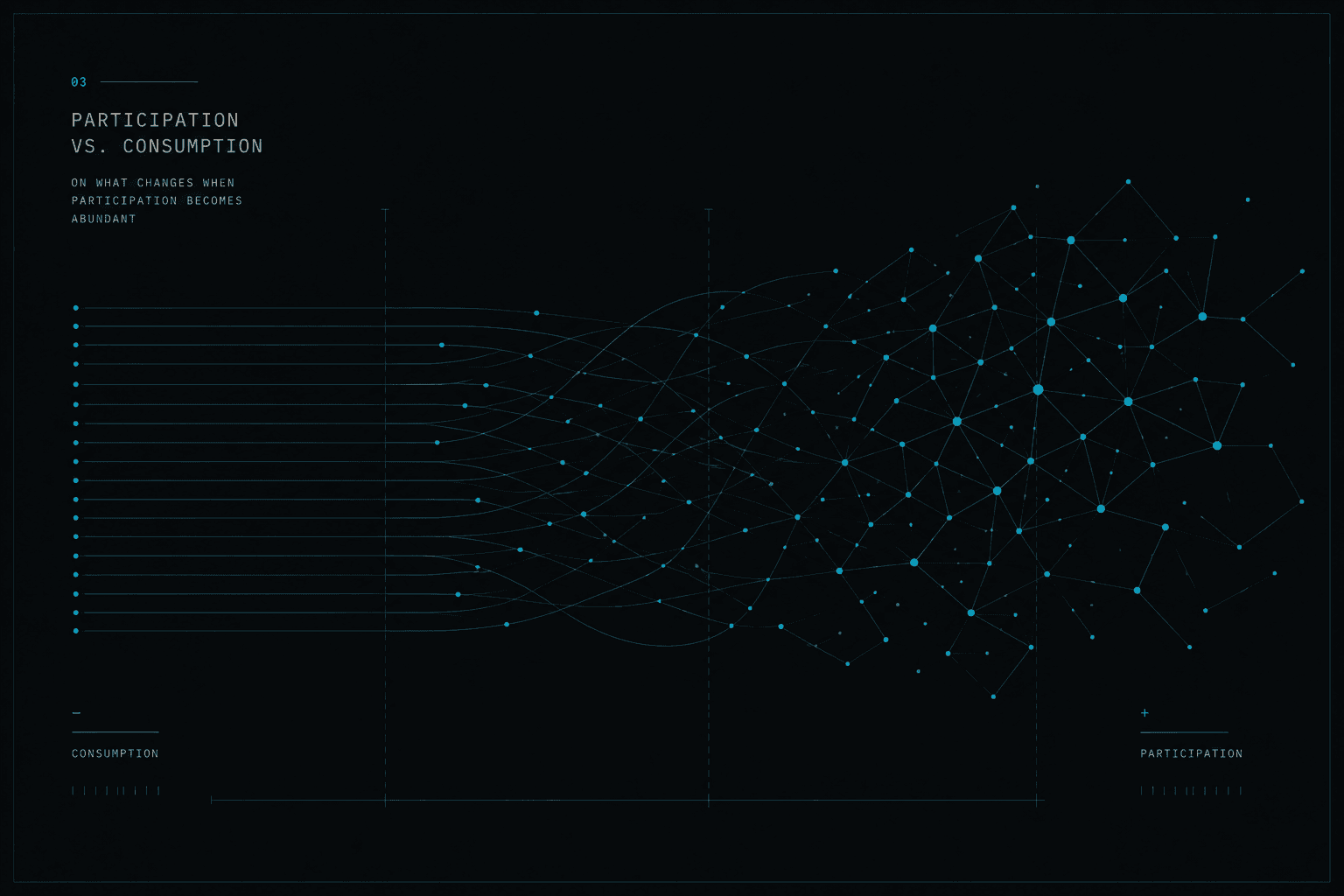
For most of human history, participation was constrained by access.
If you wanted to record music, you needed a studio. If you wanted to publish a book, you needed a publisher. If you wanted to make films, you needed expensive equipment. Even software development, something that now feels almost ordinary, required specialized knowledge and access to tools that most people simply didn't have.
It's easy to forget how recently that changed because it happened gradually. Every generation of technology lowered another barrier. Recording equipment became software. Publishing became a website. Cameras became phones. Powerful creative tools became inexpensive, then free. Today, AI is lowering many of the remaining technical barriers that once separated professionals from amateurs.
The remarkable thing isn't that everyone can create.
It's that nearly everyone now has the opportunity to participate.
I don't think we've fully understood what that means yet.
When this shift is discussed, the conversation almost always revolves around creativity. We ask whether AI is making art better or worse, whether social media has produced too many creators, or whether lowering the barrier to entry has lowered the quality of what gets made. Those are worthwhile conversations, but they all begin from the same assumption: that the story is primarily about creation.
I'm not convinced it is.
I think the more significant shift is that participation itself has become broadly accessible for the first time.
That distinction might seem semantic at first, but I think it changes the conversation entirely. Creating is only one way of participating. We also participate when we teach, mentor, curate, organize communities, document what we've learned, maintain shared spaces, or improve something that already exists. None of those activities are traditionally grouped together, but they all share the same underlying characteristic: they leave a system, a community, or a body of knowledge slightly different than they found it.
Participation isn't defined by what we produce.
It's defined by the relationship we develop with the things we care about.
That's why I don't think consumption and participation are opposites. In most cases, one naturally leads to the other. You hear music before you make it. You read before you write. You watch improv before you perform it. You play games before you design them. Consumption introduces us to a world. Participation changes our relationship with it. At some point, we stop experiencing that world as something that exists for us and begin accepting some responsibility for what it becomes.
For most of history, relatively few people had the opportunity to make that transition. Today, millions do it every day, often without thinking much about it. People teach one another, remix each other's work, contribute to open source software, organize communities around shared interests, publish research independently, collaborate across continents, and build things together without ever meeting. Those individual acts might seem small in isolation, but taken together they represent a profound shift in how culture evolves. Increasingly, culture isn't only something we inherit. It's something we actively participate in shaping.
One consequence of that shift is that we've started confusing production with participation.
It's an understandable mistake. Digital platforms naturally reward what they can measure, and production is easy to count. Posts, uploads, followers, products launched, newsletters published, videos uploaded, images generated. Those become proxies for contribution simply because they're visible.
But visibility and participation aren't the same thing.
Someone can produce constantly while contributing very little. Someone else might spend years quietly shaping a community, mentoring newcomers, documenting a process, or creating the conditions for other people to do meaningful work. One leaves behind a stream of artifacts. The other leaves behind capabilities, relationships, traditions, and cultures that continue long after the individual work is forgotten.
Production asks, "What did you make?"
Participation asks, "What did you leave better than you found it?"
That difference has become increasingly important to me because, whether we realize it or not, the systems we build teach people what participation looks like. Every product, every game, every classroom, every creative tool, every online community quietly encourages certain forms of contribution while discouraging others. We often describe those choices in terms of engagement, incentives, or user behavior, but underneath them is a simpler question.
What kind of participant is this system helping someone become?
Looking back, I think that's the question I've been circling throughout much of my own work.
Sometimes it appeared as product design, where I became interested in creating systems that felt enriching rather than extractive, even in industries where those incentives were difficult to resist. Sometimes it appeared in Dreamwave, where the ensemble mattered more than individual recognition and where the work surrounding the performances became just as important as the performances themselves. Other times it appeared through music, photography, or community building.
I don't see those as unrelated projects anymore.
I see them as different attempts to answer the same question.
Technology has given more people the opportunity to participate than at any other point in history.
That's an extraordinary thing.
It doesn't guarantee better art, healthier communities, or more thoughtful products. Lowering the barriers to participation doesn't automatically improve what happens after people walk through the door. Like every major technological shift before it, it expands what's possible while introducing entirely new questions about how we choose to use it.
To me, that's where the interesting work begins.
The remarkable thing isn't that everyone can create. That question is rapidly becoming settled. The more interesting question is what kinds of participation we choose to cultivate now that so many people have the opportunity to contribute.
I don't think that question has a single answer, and I wouldn't trust anyone who claims it does. But I do think it's one of the defining questions of our time, and it's one I've found myself returning to across nearly every medium I've explored.
In many ways, this website is another attempt to answer it.